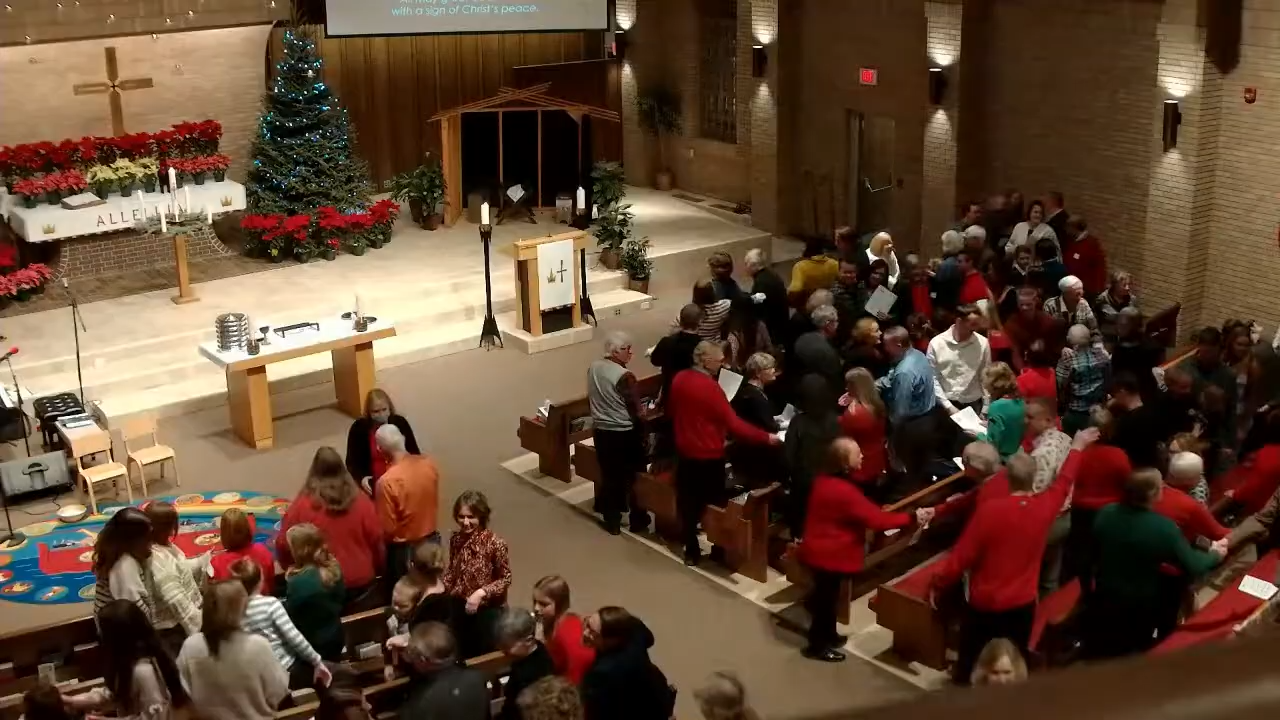
Advent & Christmas Worship Services
November 27, December 6, 13, and 20
9:30 AM Worship with Holy Communion
December 3, 10 and 17
6:30 PM Midweek Advent Worship
December 20
9:30 AM Intergenerational Pageant Worship
December 24
3:30 & 9:00 PM Candlelight Worship with Holy Communion
December 27
9:30 AM
This guide from BibleProject is intended to help you meditate on each of the weekly themes so that you might deepen your understanding of Advent and experience the season in a new way. You’ll also find an Advent calendar using the button below with daily reflections that begin on the first Sunday of Advent.
Week 1
Sometimes hope feels wishful, like crossing our fingers and dreaming of a better outcome. We might hope for better employment, healed relationships, or a brighter future. But that kind of hope is based on things that may or may not happen. When things don’t go as we hoped, it can be crushing—our hope disappearing like vapor.
As a season of reflection and contemplation, Advent invites us to imagine a different kind of hope, rooted in the unchanging nature of God and his promise to restore every part of his creation. Advent hope does not minimize pain or difficulty, nor does it assume things will soon get better. Instead, it faces the darkness with courage and chooses to trust that God’s promises will come to pass, guaranteed by his long-proven, faithful character.
In the Hebrew Bible, the words most often used for hope—qavah and yakhal—are also translated as “wait.” To hope in God means to wait with patient expectation, trusting that he will fulfill his promises. This kind of waiting leans forward, anticipating the day when Jesus will return to make all things new. Such hope empowers people to persevere, to act justly, and to serve others as a sign of the restoration that will arrive through Jesus.

Isaiah 8:5-17
Consider
When Judah’s king, Ahaz, faces the growing threat of attack from Israel’s northern kingdom, God sends the prophet Isaiah to reassure him, promising to protect Judah and urging the king to trust him (Isa. 7:1-9). But Ahaz trusts an alliance with Assyria instead, believing its strong military will bring better protection than Yahweh (see 2 Kgs. 16:1-9).
Rather than relying on the “gently flowing waters” of God’s presence (Isa. 8:6), Judah depends on the roaring river of Assyria. They will indeed get what they want, Isaiah declares. The flooding river of Assyria will wipe away their enemies, but it will also sweep into Judah. Assyria won’t completely destroy their land—the waters will come only “as far as the neck” (Isa. 8:8)—but the people will face the infamous brutality of Assyria’s warriors.
Isaiah knows what’s coming, yet he chooses to trust God. While the king is terrified, Isaiah listens to God’s voice urging him not to fear what others fear. And that voice gives him the courage to stare down the darkness with hope (Isa. 8:17).
This isn’t wishful thinking. Isaiah is patiently resisting the false security many feel when believing an empire’s military power makes them safe, and he’s refusing to let fear compel him. Isaiah says God is faithful and truly powerful; he can be trusted to ultimately save his people.
Reflect
What would it look like to patiently resist the assumption that safety comes through strength and, instead, embrace hope in God’s willingness and ability to preserve life even through darkness and death?
Psalm 130
Consider
When the psalmist cries out from “the depths” in Psalm 130:1, he reminds us that hope often rises from places of despair. Sometimes people suffer from the bad choices of others. But here, the poet asks for forgiveness, implying that the suffering he’s experiencing is the result of his own people’s (and perhaps his personal) bad decisions (see Ps. 130:4, 8). Rather than despairing, the psalmist remains confident in God’s merciful character, trusting God to forgive and exhibit loyal love.
The psalmist compares his hopeful waiting to watchmen stationed on the city walls during a long night, staying attentive to any sign of enemies. The watchmen eagerly anticipate the dawn, certain that night’s darkness cannot last forever. And the psalmist’s trust in God surpasses even the certainty that the sun will rise.
The watchmen base their confident expectation on history—the sun rises every morning. The psalmist similarly trusts in God based on history—the way God has always operated. God rescued and redeemed his people from brutal slavery in Egypt, crushing an oppressive empire thought to be unstoppable. And when Israel later rejected God by ignoring his instruction, God responded with forgiveness, revealing himself to be “compassionate and gracious, slow to anger, overflowing with loyal love and faithfulness” (Exod. 34:6b, BibleProject Translation).
Rooted in this knowledge, the psalmist trusts that God is willing and able to redeem his people from their failures and the resulting consequences (Ps. 130:7). And he invites all Israel to join him in patient, hopeful waiting.
Israel’s story suggests that human effort alone cannot fix the damage people have unleashed in God’s good world. We all need someone who can truly embody God’s wisdom and lead us back to life. Advent hope acknowledges human failure and need for God without shaming. Followers of Jesus embrace a way of patience with themselves and one another, a way of mercy and forgiveness, waiting upon the one who brings new light every morning and redeems us from every form of brokenness.
Reflect
God describes himself as “compassionate and gracious, slow to anger, overflowing with loyal love and faithfulness, maintaining loyal love for thousands, forgiving iniquity, transgression, and sin” (Ex. 34:6b-7a, BibleProject Translation). How might this understanding of God strengthen hope when you’re suffering or feeling despair?
1 Peter 1:3-9
Romans 8:18-25
Reflect
The apostles Peter and Paul both know from experience that following Jesus means neither ease nor comfort. Both men suffer intensely for choosing to follow the way of Jesus, but their hope is not weakened in the face of hardship. Instead, their hope finds clarity and strength.
Suffering often confuses us and makes us hope for more control. When suffering results from a lack of resources, we might hope for better income or improved circumstances. Hope like that can be energizing, but it’s shaky. When the thing we’re hoping for doesn’t happen, that hope will soon evaporate.
This concept of “living hope” that Peter and Paul describe is grounded in Jesus’ resurrection and God’s promise to renew all things. Both apostles see their pain not as evidence that God has abandoned them but as part of the necessary process through which God is leading the whole world.
“All creation is groaning,” Paul says, so it’s not surprising that we each suffer or “groan” inwardly (Rom. 8:21-23). We should expect it. To Paul, Peter, and the other apostles, pain and suffering clarify that their greatest hope is Jesus himself.
A “living hope” makes sense only in light of Jesus’ resurrection (see 1 Pet. 1:3). Hoping to be rescued by a dead man is futile. But Peter and Paul had their own eyewitness encounters with the resurrected Jesus (John 21; Acts 9:1-9). Seeing Jesus alive sparked a lasting, powerful, living hope.
So along with Peter, Paul, and all of Jesus’ followers, we wait with patience. We yearn for everything that’s broken to be made right. But our living hope endures, reshaping us from people compelled by fear and self-interest to people compelled by love and care for others. Like Jesus’ life on Earth, our own lives become hopeful previews of the world to come, with God’s end goal already breaking into the present.
Reflect
In your own words, how would you describe the difference between hoping for something that may or may not happen and the “living hope” Peter talks about in 1 Peter 1:3-9?
Week 2
We often hear that peace comes through strength. If our military is the most powerful fighting force, our enemies won’t challenge us and we’ll have peace. Taking the opposite approach, some try to “keep the peace” by avoiding conflict and ignoring problems, hoping they’ll solve themselves. Like Israel’s false prophets, they provide superficial harmony, saying, “Peace, peace!” But in reality, nobody is truly at peace (Jer. 6:14).
The kind of peace envisioned during Advent comes not through military victory or avoidance of reality but through the way of Jesus. He brings true peace by honestly addressing and working to heal the deeper sources of division, such as fear and pride, that compel people to violence. Jesus reconciles all things to himself, offering healing and restoration through love and forgiveness.
As Jesus continues his work of bringing real, lasting peace throughout the Earth, we can participate in that work by living as peacemakers. We join with Jesus by embracing his non-violent way of forgiveness, caring for our neighbors, and extending generous love toward all people.

Isaiah 9:1-7
Consider
Isaiah 9 speaks into a time of fear, instability, and political failure. When the Judean King Ahaz, a descendant of David, is threatened by enemy armies, he chooses to rely on Assyria, rather than trusting in God’s protection (see Isa. 7:1-17; 2 Kgs. 16:1-9). Ahaz seeks peace by relying on the power of an empire—a power that will ultimately be turned against him. Eventually, the Assyrian army marches not only against Judah’s enemies but also into Judah itself (see Isa. 8:6-8).
In the face of Ahaz’s failure, God promises to raise up a different kind of king, who will rule on David’s throne in righteousness and justice forever. As a “Prince of Peace” (Isa. 9:6), this king will secure peace not through military strength but through ending violence altogether. Isaiah’s image of breaking the “rod of their oppressor” represents destroying all instruments of war, brutality, and tyranny (Isa. 9:4). And the destruction of “every boot of the marching warrior in the roar of battle, and cloak rolled in blood” symbolizes removing all traces of war (Isa. 9:5).
When this coming ruler halts the cycle of violence, people will respond by reshaping their weapons into agricultural tools, transforming objects used for killing into objects used for cultivating and nourishing life (see Isa. 2:4). So competition over resources will give way to kindness and generous sharing of every necessity.
Following this Prince of Peace means refusing to return violence for violence. It means becoming people who embody his reconciling presence in the world. Whenever we overturn injustice and bring healing in place of harm, we are pointing toward his Kingdom of peace.
Reflect
How is the way the promised ruler in Isaiah 9:1-7 brings peace different from King Ahaz and other earthly rulers?
Colossians 1:13-23
Consider
The Jewish people waited centuries for God to send the Prince of Peace he had promised (see Isa. 9:6-7). Many expected this ruler to ascend the throne and establish peace by violently overthrowing Israel’s oppressors. So when Jesus of Nazareth comes as the true King of Israel, the way he fulfills this promise to bring peace shocks everyone.
Rather than challenging Roman overlords with a violent revolt, Jesus surrenders and appears to be defeated. He allows the religious leaders to hand him over to the Roman authorities, and they kill him on a cross. But Jesus has God’s own life, which cannot be conquered by corruption or death.
So Jesus’ surrender is not in vain. He’s compelled by love to sacrifice himself so that we might be rescued from “the domain of darkness” (Col. 1:13)—the grip of sin that leads to conflict and death. And through this, he reconciles us to God.
As we hold onto hope in Jesus and his way of life, we enter into his Kingdom, where justice and peace reign.
Reflect
Why are Jesus’ non-violent peacemaking methods so surprising both to people of his day and to us today?
Ephesians 2:11-18
Ephesians 4:1-6
Consider
God chooses Abraham’s family (later called “Israel”) to become a blessing to all the “families” or nations on Earth (Gen. 12:2-3). They’ll bless others by following God’s “instruction” (Hebrew: torah), which is intended to bring social harmony and justice. As they model God’s life-giving ways, they’ll invite others to follow them too, fostering lasting peace.
But along the way, Israel misuses God’s torah to rank Israelites as more important than non-Israelites, or Gentiles. The very torah intended to bring people together is used to exclude and diminish non-Israelites, marking who is in and who is out.
Since Gentiles don’t follow God’s instructions to circumcise their sons (see Gen. 17:9-14), they’re given a derogatory label, “the uncircumcision” (Eph. 2:11). This creates division among Jesus’ followers, marking Gentiles as hostile foreigners and strangers (Eph. 2:14-16, 19).
But Jesus lives according to torah as God intended, taking up Abraham’s calling to become a blessing to everyone on Earth. He joins both the circumcised and uncircumcised together into one unified, interdependent body, where each part works together (see 1 Cor. 12).
And bringing Jews and Gentiles together is just one expression of a larger reality. On the cross, Jesus breaks down all barriers that divide his followers. Things like ethnic background, gender, and socioeconomic situation don’t have any bearing on people’s status within the community and shouldn’t be used to break people into factions (see Gal. 3:28).
Ongoing hostilities within the Church make no sense because Jesus has already destroyed them on the cross (Eph. 2:14-16). The tendency to create divisions stems from a debunked system that values some human beings more than others. Because of what Jesus has done, we are all equally loved and valued in the family of God. So Ephesians 4:1-6 calls God’s people to live out the reality that Jesus has already accomplished. God’s people are one body, so they are to live as one body. By loving one another humbly, gently, and patiently, they will embody a true and lasting peace and fulfill their calling to bless the world.
Reflect
Where do you find it most challenging to live peacefully with others? How might God be inviting you to approach those situations?
Week 3
We often think about joy as an experience of happiness based on favorable circumstances: a stroke of good luck, a personal achievement, or a long-held desire finally being satisfied. But when joy depends on circumstances, it fades fast when the good times end.
Advent joy is not about general happiness stemming from good times. It’s a deep sense of safety and freedom people feel because of God’s loving character, which remains constant through all circumstances, and because God can be trusted to ultimately bless and heal creation as he promised. Similar to the joy a friend’s presence brings on good days and bad, we experience joy as God walks with us through the fluctuations of life’s positive and painful circumstances.
In the Bible, people express joy both when God delivers them from situations of oppression and while still in the middle of exile, persecution, and pain. As people remember God’s loving, rescuing actions throughout history, they wait in joyful hope for him to act in the future, even when that waiting requires patient suffering.
This kind of joy is about being united with the God who walks with us and trusting that he will one day wipe away every tear. It looks to the future but also takes root in our present reality. The season of Advent invites us to experience joy not because everything is perfect but because God is with us and his joy is already breaking into the world.

Psalm 105:43
Isaiah 51:1-11
Consider
Some of the most vivid expressions of joy in the Bible are responses to God’s powerful acts of deliverance. Psalm 105 celebrates how the Israelites went out “with joy” at the exodus, when God rescued them from slavery in Egypt (Ps. 105:43). Their joy flowed from the realization that God saw and heard their suffering (see Exod. 2:23-25), the overwhelming relief of being set free from oppression, and the gift of God’s guidance toward a new home.
When Israel later ends up oppressed in Babylonian exile, the prophets look ahead to a second exodus. Isaiah 51:1-11 imagines Zion (another name for Jerusalem) as once desolate but now bursting with life and song, transformed from a wasteland into a joyful garden. Just as God earlier parted the Red Sea to make a path through chaotic waters and free his people from enslavement (see Exod. 14), now he will make a new path for their return to the promised land. As they come home rejoicing, “sorrow and sighing will flee away” (Isa. 51:11).
During Advent, people often spend time reflecting on the joy sparked by God’s powerful acts of deliverance in the past, which can lead to joyfully anticipating how God will act again in the future.
Reflect
How might God’s past faithfulness help us walk in joy today, even as the journey introduces suffering and takes longer than we’d prefer?
Luke 2:8-14
John 15:9-17
Consider
On the day of Jesus’ advent, an angel announces to a group of shepherds that God’s promised king is arriving in Bethlehem. This message is “good news of great joy which will be for all the people” (Luke 2:10). For centuries, Israel languished under foreign empires, longing for the arrival of God’s promised king who would bring lasting justice, peace, and healing (see Isa. 9:6-7, 11:1-9). But when the angel joyfully proclaims that this king has finally come, the people are not expecting this kind of arrival—or this kind of king.
Jesus does not overthrow human enemies or establish a dominant throne in Jerusalem. Instead, he challenges the root cause of his people’s suffering by fighting their true enemies—sin and death. These are the powerful forces of corruption that not only fuel Rome’s oppression but also enslave all humanity and compel every form of evil. By defeating these enemies, Jesus invites us into a new way of life in his Kingdom of humility, generosity, and love.
Jesus explains that by living according to his instruction, people receive his own joy, which eventually becomes “full” or “complete” (Greek: pleroo, John 15:11). And the most fundamental way to follow his instruction, he says, is to “love one another, just as I have loved you” (John 15:12).
Jesus is not inviting people to embrace generally warm affections toward others. He wants them to love others as he has loved them. Real joy is rooted in the self-giving love of Jesus.
Reflect
Consider the claim that true joy is found in self-giving love and following the way of Jesus. How does this relate to popular assumptions about joy today?
Matthew 5:11-12
1 Corinthians 6:1-10
Consider
In Jesus’ most well-known teaching, the Sermon on the Mount, he surprisingly calls people to “rejoice and be glad” when they’re persecuted for following him (Matt. 5:11-12). He’s not suggesting they should suppress their pain or pretend suffering doesn’t matter. Instead, he’s offering an invitation to see hardship through a radically different lens, one that regards suffering as worth it when you’re suffering for doing what’s right.
To suffer for doing good is to join a long line of people who have walked Jesus’ path. The Apostle Paul and his associates face public beatings, hunger, and exhaustion for sharing the good news about Jesus, and Paul says they are “sorrowful yet always rejoicing” throughout their trials (2 Cor. 6:10). His words are a testimony to a joy that runs deeper than pain as it joins God’s good work of restoring the world.
This is the paradox of Advent joy. It does not ignore or minimize sorrow but transforms the way we experience it. Because we are united with the living Jesus, who has promised to return to complete his work of restoration, we can experience a joy that perseveres and enlivens us, even through the darkest circumstances. In Jesus, we find a joy that can coexist with grief and even grow stronger in its midst.
Reflect
Where in your life are joy and sorrow intermingled? How might God be forming deeper joy in you, not in spite of suffering but through it?
Week 4
Love is often seen as a force beyond our control, something people fall in or out of. Or it may seem like something satisfying that we can achieve, driving us to chase affection through relationships or status. “Love is all you need,” they say, because it’s the path to self-fulfillment.
But something is missing from that picture of love. The Bible invites us to see a kind of love that’s neither accidental nor driven by desire for self-fulfillment. Instead, it involves a steady commitment to care for the well-being of others—never self-seeking, always self-giving—even when it costs us.
Jesus shows this kind of love when he gives his life for friends and enemies alike. Dying on a cross, with his killers still laughing at him, Jesus cares for their well-being as he prays for their forgiveness (Luke 23:34). Living with this kind of love does not mean ignoring our own needs or devaluing ourselves. After all, Jesus says to “love your neighbor as yourself” (Matt. 22:39). But it means choosing to see all people as living miracles of God, each made in God’s image and deeply loved by him.
The Advent season leads us to reflect on the future God is bringing, where every interaction will be shaped and compelled by love. Even more, it invites us to live into that coming world right now by loving others the way Jesus does. As we give of ourselves in order to care for both friends and enemies, we demonstrate the love that Jesus shows to all people.

Deuteronomy 6:5
Leviticus 19:18
Mark 12:28-31
Luke 6:27-36
Consider
When a religious law expert quizzes Jesus about God’s most important commandment, Jesus references two Hebrew Bible texts: “Love the LORD your God with all your heart” (see Deut. 6:5) and “love your neighbor as yourself” (see Lev. 19:18). To Jesus, these instructions belong together because loving God is, at the same time, loving others. To love God but not people is impossible because God creates every human being in his own image (Gen. 1:26-27).
Jesus challenges his followers to go beyond loving only their families or the people they’re most comfortable around. He teaches an impartial love, one that chooses to love both friend and enemy, seeing them first as humans made in God’s image, his beloved creations.
In Jesus’ time, this command includes loving the largely despised Roman military forces, who are occupying and dominating the Jewish people’s land. And he even gives examples of how to show them love. When a soldier slaps you, respond with assertive non-violence by offering your other cheek (Luke 6:29; also Matt. 5:39). When a soldier lawfully demands something from you, give generously more than he demands (Matt. 5:41), always choosing mercy over retaliation.
These may seem like passive acts of surrender, but they are actually forms of active resistance. Instead of mirroring or escalating harm, these responses creatively offer a better way forward, patiently inviting our enemies into a different kind of relationship. Jesus calls his followers to live in a way that trusts love to disrupt injustice, disarm hostility, and reflect the character of God.
This kind of love isn’t easy, but it has the power to overcome evil and heal the harm it causes. God’s Kingdom shows itself in the world not through force or domination but through courageous acts of love.
Reflect
What might it look like to love someone in your life the way Jesus describes here?
1 John 4:7-21
Consider
In one of the most powerful reflections on love in the Bible, the Apostle John writes, “God is love” (1 John 4:8). Love is the way God chooses to act, yes, but it runs deeper: Love is his very essence. So if we truly know who God is, that knowledge will show up in the tangible ways we love others.
We show our love for God by loving the people who are made in his image (1 John 4:20; see Gen. 1:26-27). Love for God and love for neighbor are inseparably bound together as one way of thinking, feeling, and acting (see Mark 12:28-31). We see this way of living most clearly in Jesus.
Jesus’ love is active, costly, and directed toward healing the broken, forgiving the sinful, and restoring peace to the battle-worn and exhausted. God the Son enters humankind in Jesus, not because God pities us or because we finally did enough good to deserve his help. Instead, God lowers himself, taking on flesh and human suffering—including death—because God is love. Love moves toward the good of the other. And Jesus moves into our world, into our neighborhood, for our good.
This kind of love cannot be manufactured. We develop Jesus-style love when we choose to abide in God’s love and be shaped and transformed by it. Living in the way of Jesus opens our eyes to see others the way God sees them. And when we see people through the eyes of love, that love shines through us in practical, helpful ways.
Advent reminds us that love itself is God’s essential nature and should permeate his creation. As we choose to embrace God’s way of love, we begin to reflect it throughout the world.
Reflect
How have you experienced God’s love through other people? What’s one way you can reflect God’s love to someone this week?
1 Corinthians 13:1-13
Consider
At weddings or other occasions where love is in the air, you might hear words from 1 Corinthians 13, the Apostle Paul’s most famous writing about love. “Love is patient, love is kind, it is not jealous; love does not brag, it is not arrogant” (1 Cor. 13:4). But 1 Corinthians 13 does not focus on what we call “romantic” love; instead, it describes a love that holds communities together when deep divisions threaten to tear them apart.
Paul is writing to a Corinthian community that has fractured, with high-status people receiving privileges denied to others. Some members are elevating themselves by boasting about their spiritual gifts—that is, Spirit-empowered abilities like spontaneously communicating in foreign languages or speaking the words of God to people—while others are being excluded or branded as lesser.
Paul reminds everyone that spiritual gifts are for the benefit of others, not for boosting personal status. Although they are powerful, they mean nothing if they aren’t compelled by love, a love that “always protects, always trusts, always hopes, always perseveres” (1 Cor. 13:7, NIV).
For Paul, love is the rugged commitment to relate rightly with people and seek their good. It bears with others’ shortcomings and refuses to dominate or keep score.
Advent reminds us that this kind of love is grounded in the hope that God is working to renew all things and will one day fully establish his Kingdom on Earth as it is in Heaven. As we practice this way of love, friends, neighbors, and even enemies can glimpse that future reality.
In the end, it’s not prowess, power, or performance that will last. It’s love.
Reflect
Of the many aspects of love described in 1 Corinthians 13, which encourages or inspires you the most, and which seems most difficult to put into practice?



Advent Giving

Support the CtK Foundation
Are you looking for a unique gift for that loved one that has everything? Consider giving a gift in their honor to the CtK Foundation!
Your gift, large or small becomes part of the asset base of the Foundation and 5% annually is given out in grant awards.
Your gift may help someone locally or globally where every small gift goes a long ways! Or funding may go towards supporting CtK projects such as the Organ or Solar Panels.
Checks can be made payable to: CtK Foundation and sent to the church or put in the offering plate. Just be sure you include “Foundation” in the Pay to or Memo as the Foundation is a separate 501c3 charitable organization.

Donate to Ralph Reeder
Monetary donations will be used to address a variety of needs related to food insecurity, including:
-
Purchasing food and other essentials for food shelf participants.
-
Providing food services for children that include weekend snack packs, smart snacks, and summer food boxes.
-
Offering need-based scholarships for enrichment and supplemental learning opportunities.
ELCA Good Gifts

"As members of the Evangelical Lutheran Church in America (ELCA), we believe that God is calling us into the world — together. And with generous, loving hands, we can make a difference.
ELCA Good Gifts is your opportunity to provide critical support to the ministries and programs that mean the most to you and the people you love."
Give HERE

-
Location
Contact
Office Hours
 A Reconciling in Christ Partner
 A member congregation of the Evangelical Lutheran Church of America